Monday, July 30, 2012

Mind your Qs

Recently, a cousin of mine came over to visit with her 75-year-old mum. Throughout the visit when we were showing them around our estate, Andre held his grandaunt's hand and walked slowly beside her. Later, my cousin commented that Andre was very good with the elderly.

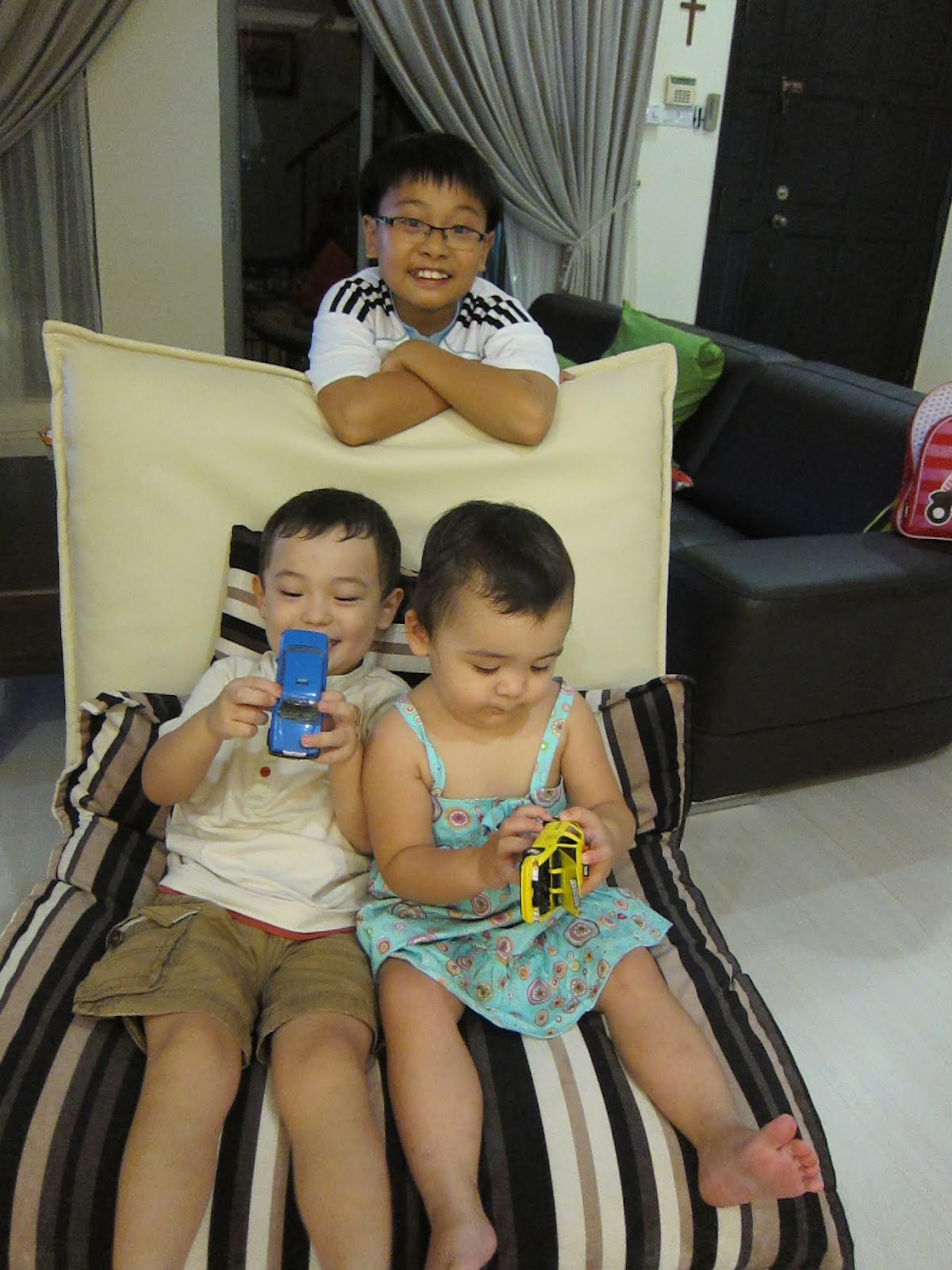
That comment surprised me as I'd never thought of Andre being particularly adept with the elderly. I have noticed however, that he seems to have this natural knack for looking after others. Whenever my good friends Isabelle and Joon visit with their two toddlers (or when we visit them), Andre will automatically assume the role of the big "korkor" and entertain the kiddos, much to their delight.

He'll share his toy taxi collection...

... and even bring them on a ride in their wagon.

For a long time now, we've known that Andre is very much a people person. I don't think he can explain it in so many words but often, he seems to understand intuitively what others need. For instance, there's a boy in Andre's class with a serious skin disorder that afflicts his entire body. He has to apply this ointment that leaves a sticky residue and many kids are repelled by this. In fact, some of the kids have called him "Monster" which obviously upsets the poor boy. Kids can be so cruel.

When Andre told me he sometimes sits next to this boy and just be his friend, I thought it was very sweet of him.

A few months back, I read a Forbes online article entitled "Intelligence is Overrated: What You Really Need to Succeed". Essentially, it states that while IQ is often used as a criterion for climbing the corporate ladder, it is actually your other "intelligences" - emotional, moral and body - that are bigger determinants of financial success.

I found this statement particularly interesting:
"Nobel Prize winning Israeli-American psychologist, Daniel Kahneman, found that people would rather do business with a person they like and trust rather than someone they don’t, even if the likeable person is offering a lower quality product or service at a higher price."
Once, a friend of mine, who's a badminton fan, invited Andre to join him at a game at Sengkang Recreation Centre. Andre was terribly excited by the invite and at first wanted to ask his best friend who stays at Sengkang along. After some thought though, he told Kenneth, "No, I better not. It's not my court, it won't be nice."

That's when Kenneth told me, he was less worried about Andre's future because here's a boy with EQ.

As you probably know by now, I constantly worry about Andre, especially academically. Even though I know academics is not everything in life, it's hard to shed the mother hen complex. But when I hear how Andre tries to be a good friend to others, it warms my heart and it goes a long way in assuaging my concerns.

In life, there really are few qualities as important as kindness to others. Perhaps Andre's the one who's gotten it right all along.

Monday, July 23, 2012

The final answer is...

Andre is now in the thick of PSLE revision, counting down to the dreaded exam (2 and a half months) and as you can imagine, it's a very painful period for everyone involved.

To me, it's a total waste of a year. He hardly learned anything new - the entire year is practically spent trying to perfect exam techniques by doing exam papers ad nauseum. And for what? PSLE is essentially just a glorified, high-stakes school placement test. It's extremely meaningless and experience-diminishing.

Not to mention, the stress has turned my happy-go-lucky boy into a snappish, angsty pre-teen. I can't wait for it to be over.

In the course of PSLE preparation, there are times when I've despaired over Andre's off-the-wall answers to exam paper questions. In Science, for example, there was a question: "Why are the butterfly chrysalises either brown or green?"

His reply: "Depends whether they ate brown or green plants."

Sometimes, his command of the English language lands him in trouble, like his answer to this question: "Why is it not advisable for a man to place plants in the room where he sleeps?"

His reply: "The plants will fight the man for oxygen."

Wah, monster plants, like Little Shop of Horrors.

One particular question stuck out in my memory. Andre was doing an English paper and as part of the comprehension cloze passage where you have to fill in appropriate words in the blanks, there was this sentence:

"The Trojan war was fought against the city of Troy in Asia Minor which is __________ -day Turkey."

The correct word for the blank is "modern". Andre however, took one look at "day" and "Turkey" (never mind that it's capitalised) and filled in "Thanksgiving".

I know I was yelling at him while shrieking in laughter at the same time. Talk about comic relief.

On a more serious note, I know it's PSLE fatigue when he cares more about getting the work done than getting it right. I'm despairing over his immaturity, yet part of me resents the fact that I have to force him to jump through hoops. And I know I'm not the only one going through this angst. You can usually spot the mum with a PSLE kid cos she's the one who looks the most frazzled.

This is even more so if her child is a boy. Generally speaking, boys mature later. Many of the boys in Andre's class talk and behave like 7-year-olds while the girls look like they've got their future all planned out. In that sense, PSLE favours girls because it calls for extreme discipline, meticulous care and the patience to do repetitive tasks over and over again.

My brother-in-law who has taught Sunday school for secondary level kids, recounts that the girls are usually very socially clued in whereas the boys, especially at sec 1, seem not to know what they're doing there and appear to live on their own planet. Only when they hit sec 3 or 4 (or even later), the boys will suddenly wake up and then outshine the girls.

I realise that we're sometimes in a hurry for our kids to grow up, for silly reasons like the PSLE. We let the system dictate the timetable of our kids' maturity, which is just wrong.

So I'm trying to tell myself to let Andre mature at his own pace. Instead of wishing away his innocence, I should enjoy it while it lasts. It will disappear soon enough.

Monday, July 16, 2012

Don’t throw away the arithmetic yet

After I wrote a guest post on White Group Maths, I asked Frederick if he would like to reciprocate as I like his simple yet engaging style of writing. Happily, he agreed so here's his post. Slightly irreverent, yet relevant. For all the non maths enthusiasts, hopefully this will pique your interest in the subject!

xxxxxxxxxxxxxxxxxxxxxxx

“A new car built by my company leaves somewhere traveling at 60 mph. The rear differential locks up. The car crashes and burns with everyone trapped inside. Now, should we initiate a recall? Take the number of vehicles in the field, A, multiply by the probable rate of failure, B, multiply by the average out-of-court settlement, C. A times B times C equals X. If X is less than the cost of a recall, we don't do one”- Narrator (Fight Club, 1999)

Seriously? Using algebra on the job? Not unless one is deeply involved with actuarial work. Things would get messier if the person is an aerospace engineer we are talking about, since he has to formulate specific mathematical models to simulate efficiency of avionics systems. Or a rocket scientist who has to……… ok I shall stop, because this is the point when the average Joe would scream total irrelevance. The comforting truth is, for majority of us peace-loving, ordinary folks, the amount of mathematics which actually wriggle into our livelihoods to taunt and torment is far much lesser. In fact, almost all the knowledge acquired in school (horrors of horrors such as calculus, complex numbers, vectors et cetera) would be relegated to the junk folder of our memory banks from the very instant we graduate and step into the working world, never to be revisited again in our future endeavours.

That said, there are a few basic math skills definitely worth preserving throughout adulthood, chief amongst them is arithmetic (which includes mental calculation to a certain extent). What then, as one may question, is the value of being able to count competently and efficiently? Herein I shall share five benefits you would be rewarded with in daily living:

1. Producing fairly accurate ascertainment of costs on the spot

Say there is a 50 dollar note resting snugly within your wallet, and you have decided to give yourself a nice treat. This restaurant with a particularly unique ambience and good food is offering a classy buffet spread at $44.90, exclusive of the additional 10% service charge and 7% GST. Will you end up washing the dishes for a whole day in their kitchen because you didn’t have sufficient funds to make payment? Rounding up the cost to $45, and doing a quick mental check that the 10% service charge is equivalent to $4.50 (which therefore gives a sub-total of approximately 50 bucks without factoring in the other 7% surcharge), you would have concluded it is wise to give this place a miss for the moment.

2. Prudent budgeting

This absolutely goes hand in hand with prudent spending. At some point in our lives, the temptation to shell out cash to get that big-ticket item is just excruciatingly overwhelming. Should you succumb to the devil or postpone the purchase? Or perhaps clench your teeth and walk away forever? A little diligent math done beforehand coupled with a rational, disciplined mind-set would help prevent penalisation in the form of a deeper shade of red on your personal balance sheet. And all it takes is a typically straightforward process of adding and subtracting of numbers, with some interest rates thrown in as multiplication factors if you are looking at a bank loan for financing purposes. It is indeed as easy as it sounds.

3. Reconciling facts with statistics

Statistics can be augmented to present a fictional truth, however blunt, raw facts never lie. Think: an ailing man is considering undergoing a major surgical procedure, and an unscrupulous hospital cites success rates of 75 percent. An independent study by a non-profit medical foundation demonstrates that in a recent batch of 100 patients who were wheeled into operating theatres worldwide, 60 came out with white sheets draped over them. If his tingling mathematical sense kicked in to warn him of this existing discrepancy, he would think twice (probably thrice) before putting his signature on the consent form. That moment of pause could have well given him greater clarity in planning his next course of action. Moral of the story: be discerning by doing your own math homework, as this saves you the potential agony of being deceived by conniving, slippery salesmen. And it might save your life too.

4. Impressing that girl

Neil Strauss completely forgot about penning this down in his book “The Game”, so here is the tip: you can in fact impress the hot girl of your dreams with your superior mental calculation skills. Say she is totalling up the impending bill for her cart of groceries in one corner of the supermarket using her fingers, and you swoop in to give her the correct grand figure. Chances are she can’t take her eyes off you, at least for a while. Tried and tested by yours sincerely, and works like a charm.

5. Keeping Dementia at bay

While a cure currently still eludes scientists and doctors, studies have shown that maintaining cognitive fitness goes some way in delaying the progression of symptoms, thereby enhancing the overall quality of life. Hence, start entertaining yourself with KENKEN puzzles, and reduce the odds of being ravaged by old-age Alzheimer’s.


Frederick Koh is a teacher residing in Singapore who specialises in teaching the A level maths curriculum. He has accumulated more than a decade of tutoring experience and loves to share his passion for mathematics on his personal site www.whitegroupmaths.com

Monday, July 9, 2012

Do we really need to learn calculus in school?

I received a request from Frederick Koh, a JC maths tutor asking me to contribute a guest post on his blog, White Group Mathematics. My first reaction was maths? What do I know about maths?

He then clarified that I didn't actually have to write something on maths, just anything on education but the obsessive personality that I am thought a maths-related post would be more appropriate.

Objectively, I think I have enough of a logical brain to tackle basic maths. I coached both my kids in primary school maths and there's something about the puzzle-solving aspects of primary school maths that appeal to me. My personal experience with maths was generally positive too - I sailed through maths in primary school and E Maths at 'O' levels.

However, this led me to erroneously believe that I could manage Maths C at 'A' levels even though I hadn't studied Add Maths at 'O' levels. Boy, was I wrong. I sat in oblivion throughout the 2 years, despite my classmates' best efforts to help. The tutor practically gave up on me and skipped past me whenever he asked my classmates a question. In the end, by a miracle, I achieved a C grade, to which the tutor reacted epically - "You?? You got a C???"

There's just something about the strings of random numbers that baffle my mostly right brain. Sometimes, they're attached to letters, other times, with funny incomprehensible squiggles and notations. Worst still, sometimes the numbers don't even line up in the same row (miniature ones written above or below other numbers like they're an afterthought). It's like Morse code in an alien language.

I have a PRC friend and back in China, he was in the gifted programme for maths. He shared how in China, there are only gifted programmes for maths and science - such is the emphasis on what is commonly perceived as the pragmatic and "superior" subjects.

"What about China's great legacy of literature and the arts?" I asked. He explained that the government felt China's heritage in the arts caused the country's economic decline so they are now over-compensating. In fact, he told me that all the current China leaders have backgrounds in maths or science.

He feels that this complete neglect of the humanities is a great disservice to Chinese kids. He cites his own example where he wishes that he had learned more soft skills like communications, people management and so on so he can better function at work. He says up to today, he has yet to apply any of the calculus he'd studied (even though he once worked as an engineer).

As someone who's always been in the humanities underdog camp, it isn't hard for me to sympathise with him. But I got to thinking, there are actually two different controversies at work here.

The more obvious one is clearly the maths/science-humanities struggle. Which is more important? It would be easy for me to side with the humanities but my answer is both, and I'm not just trying to be politically correct. The maths and sciences set the foundation for logical thinking and deduction, there's no denying the importance of this. It's not enough just to be able to give customers the correct change or work out how much that bag of apples at the supermarket costs. That's why even though Lesley-Anne doesn't have the aptitude for maths, I tell her that having a good foundation of maths is important.

As for the humanities, well, it fosters critical thinking and deeper reflection into the intangibles, into human behaviour. Much in this world is different shades of grey, not black-and-white. Solutions often can't be calculated via a fixed formula or measured on a quantitative scale, and the humanities teach us how to wrap our minds around the fuzzy and give it meaning. In this connected world where people brashly push forth their arguments and opinions, it's more important than ever not to blindly believe what you read and to question everything with a critical mind. (Yes, including my post).

But beyond the superficial maths/science vs humanities conundrum lies another conflict in my friend's statement. He felt that the years he spent learning calculus would have been better spent learning skills like communication because he could use it in real life. It's this intrinsic belief that in education, what you learn must be usable to be considered useful.

Granted, if you're training to be a mechanic, I sure hope whatever you learn will be useful enough to enable you to fix my car. But this idea that education has to be practical is essentially another left brain argument. To me, it dilutes the value of education because it reduces education to yet another commodity.

It means that if you don't intend to draw, there's no point in learning art. By that same token, learning Chinese is needed only if we intend to do future business with China. I've always thought this moot point as I suspect all the enterprising Chinese entrepreneurs are mastering English as we speak, for the same pragmatic reasons.

Education is not the same as training, it has to have a higher purpose. That's been one of the main criticisms of the Singapore education system, that it doesn't educate individuals, it trains them. Beyond learning how to read and write, count apples and how gravity works, education should enable us to be more thinking versions of ourselves.

At every level, we should have this, to different degrees. At primary school, it could be as simple as asking questions about a science experiment. At secondary school, critical analysis of a social issue. At JC and university? Well, why not calculus?

Right upfront, I'll say the only thing I know about Calculus is that it's the name of a character in the Tintin comics. I looked at the universal authority on all things aka wikipedia and here's what it says: Calculus (Latin: a small stone used for counting) is a branch of mathematics focused on limits, functions, derivatives, integrals and infinite series.

Ahhhh... nope. Catch no ball.

But despite my ignorance about calculus, I'm pretty certain that calculus does make you think deeper about certain concepts of maths. And as long as something you learn in school helps you exercise your brain in thinking deeper and more laterally, chances are, it's valuable. You just don't know it. The same way that many people think literature isn't useful cos nobody spouts poetry at work in real life. But literature helps you read between the lines, analyse human behaviour and appreciate the subtleties of the written word, all of which is important in life.

So I wouldn't write off calculus just yet. (Do I hear Frederick heave a sigh of relief?) As I've always advised parents, when your child has to choose his or her subject combinations, instead of saying, "take the most useful one" (which is only marginally better than "take the subjects you can score in" or "take the subjects that can earn you the most money"), tell them to take the subjects they're passionate about. Passion ignites learning and from there, they will have a better chance of extracting value from it and becoming more thinking individuals.

That's what education is all about.


This post was published on White Group Mathematics here.

Monday, July 2, 2012

Have your cake and eat it

Our family meals tend to be eat-and-go events, even when we're at a nice restaurant. I not sure why but somehow, we're unable to dine at a leisurely pace.

Last week, we were at Coffee Club and the minute the waiter placed our dessert order on the table, three forks swiftly moved into position, waiting to pounce.

"Can we at least try to make this last more than 5 minutes?" I propositioned.

"Why?" asked my impatient comrades as they attacked the cake with relish.

At the next table, I saw a similar dessert sitting pristinely on the table, hardly touched as three family members casually chatted. I pointed this out to my two kids who were seemingly trying to devour the cake in record time. "See how civilised other people are?"

Lesley-Anne retorted, "They will never survive in the wild. These are the Hunger Games."

Without skipping a beat, Andre declared as he polished off the last bite, "May the odds be ever in your flavour."

Savages. I'm raising savages.

Monday, June 25, 2012

Book recommendations for action and fantasy loving kids

Recently, Andre showed interest in a couple of books, so I thought it would be timely to share the finds. My two recommendations today are book sets in the fantasy genre with lots of action.

The first recommendation is not much of a surprise, it's Suzanne Collins' Hunger Games trilogy. Interestingly enough, I bought the first book for myself on a friend's recommendation, before the movie was released and before I'd heard all the hype. The book got me so hooked I went out and bought the entire box set from Popular. This is an exceptional series. I say this because it is the first series of books where every member of my family actually read and enjoyed. That's right - Kenneth, Lesley-Anne, Andre and me! Talk about value for money.

I don't know how Collins did it but she writes in such a way that's simple enough for a child of 11 to understand yet sophisticated enough to engage adults. The themes are also pretty gender-neutral. Just a quick blurb, the Hunger Games is set in a hostile land where every year, 24 children have to fight to the death in a terrifying live event that's televised to the citizens. Only the winner survives. The protagonist is 16-year-old Katniss Everdeen who volunteers to take her younger sister's place in the games.

We never caught the movie. In my experience, movie adaptations seldom live up to the magnificence of the book which can better capture every thought and nuance. The book is fast-paced and there's non-stop action which is great for Andre. He loved it even more than the Percy Jackson series. I'd never seen him so engrossed in a book that he chose to read it over computer time. If that's not incentive for all you parents with reading-averse kids, I don't know what is!

The second series, which Andre is currently reading, is Maximum Ride by James Patterson. It chronicles the lives of six fugitive children known as the Flock, who underwent scientific experiments that made them 98% human and 2% avian. The main character is 14-year-old Maximum "Max" Ride (another female protagonist!), leader of the Flock.

There are seven books altogether, divided into two sections: The Fugitives (books 1–3) and The Protectors (books 4–7). Andre started reading this series upon the recommendation of Lesley-Anne who enjoyed it tremendously at p6. The storyline is compelling enough to hook his interest. However, from book 4 onwards, I understand the writer started focusing on the love story between Max and Fang (another member of the Flock), which put Lesley-Anne off. If you're not keen on your pre-teen reading love stories, then stop at book 3.

I understand that Maximum Ride will also be adapted into a movie, to be released next year.

I would estimate the reading level of both these series as suitable for age 11 onwards, although the themes are probably targeted at teenagers.

Wednesday, June 20, 2012

Of Kids and Education is on Facebook!

Ever so often, I would receive friend requests on Facebook by readers of this blog. However, since I prefer to keep my Facebook friends to people I actually know, I usually don't accept those requests.

Nevertheless, I do want to connect with my readers and fans and the blog platform is a little limited since they can only do so via the comments. Many readers, especially those too shy to comment, have thus remained faceless to me, which isn't ideal. I would love this to be a two-way street. So what I've done is to set up a community page for this blog on Facebook. It's something I guess I should have done a long time ago but just never got around to it.

The thought is that it will be a place where my readers can share their views on education and kids in general, and also interact with me and other like-minded parents, hence the name "Community". It's also there that I will post updates on this blog and any other random thoughts, Facebook-style.

I hope you will support me in this. Just click on the "Like" button on the top right hand corner of this page and visit the FB page to join in the community. See you there!

Saturday, June 16, 2012

Chope... akan datang

This is not a post. This is an advertisement of sorts to let you know not to expect another post here at least until the school holidays are over.

Reasons:

1) It's the school holidays. My engine automatically screeches to a halt (as all mums of school-going children know, our circadian rhythm coincides with that of our kids). Often, my body is up at 9am but the brain doesn't cotton on till noon.

2) I was supposed to be updating my Travel Blog on our family trip to Darwin. For some reason, it's taking me longer to write about this 5-day trip than our three-times-as-long New Zealand trip last year. Bear with me and keep checking back there, I promise it will get done eventually.

3) In my defence, I did write a pretty long post before this - a substantial one talking about the education system and everything. I figure that justifies me to a two-week or so reprieve.

So, enjoy the break and I'll be right back.

Friday, June 8, 2012

Education stress - whose fault?

In a recent media interview, Minister for Education Heng Swee Keat told parents that they had to accept new methods of teaching to prepare children for the future.

Rightly or wrongly, I was disappointed. Not because I don't agree with him but because it would appear that he missed the point. I don't think parents are anxious so much about the new methods as the fact that we seem to be constantly chasing an upwardly moving (and evolving) target. Stress over new methods is simply a symptom.

Incidentally, I thought it was funny that he used algebra vs the MOE method of maths models as an example of old (bad) vs new (good). I'm a big proponent of maths models myself but come on, it's essentially two different methods to solve the SAME problems. We're not actually teaching our kids how to solve new problems so I don't see how it better prepares them for the future. And by the way, someone should tell him that maths in secondary school reverts to algebra. Nobody touches maths models after p6. So much for continuity.

What I was disappointed with was that instead of addressing parents' anxiety, he seems to put the blame squarely on parents.

After I wrote my letter to him last year, I received some comments saying that parents are at fault too for being kiasu and myopic. I've never denied that. I've always maintained that our society does not exist in a vacuum and there are usually many contributing factors to any breakdown in a system. So I will now state categorically that I believe parents are at fault too.

In an interview for a Dan Rathers tv documentary, I was asked why Singapore parents are so involved in their kids' education, I told them it's a cultural legacy. If there's a common thread among Asian parents, it's our focus on education. Truth is, we all have some degree of the Tiger Mum syndrome. Some parents might protest, not true! I'm not one of those kiasu ones! I would like a less stressful system so my kids can enjoy their childhood and not mug all the time.

But from speaking to many parents, I know that most of us still want our kids to do well in school and by well, I mean just that little bit better than others. Most of the time, parents are stressed because they feel their kids are not keeping up with others. Ask yourself how often you've grilled your kid on how his other classmates did. I'll use my own example - when Andre gets 68 for a maths exam, if I find out that the class average was 50, I breathe easy. If the class average was 80, however, I go into panic mode.

It's no coincidence that the most academically competitive countries are Asian - China, India, Japan, South Korea and you can add Singapore. Asian countries also typically ace international maths and science tests, practically sweeping the top 5 in the TIMSS 2007 maths test and science test. The results don't even include China which didn't participate in the test.

Asian parents focus on academics no matter where they are. In Western countries, the Asian geek stereotype with parents who scorn any grade lower than an A didn't come about by accident. Asian parents just push academics harder. We can't help it, it's in our blood.

I know quite a few parents who are living overseas and tell me oh, it's so relaxed there and that's how education should be, about discovery. See, we're not kiasu. Here's what I think: sure, it's partly because the Singapore system drives kiasu behaviour, but maybe it's also because in the Western countries, it doesn't take that much effort for their kids to score well. It's certainly not because Western kids have lower IQs, it's just that they simply don't care as much about grades as we do so they don't put in as much effort.

Asian kids routinely top the honour rolls and sweep the academic medals overseas, sometimes without that much extra effort (I'm comparing to Singapore). It could be just a little parental coaching at home. If our kids can perform well, of course we can relax and not ply them with assessment books or tuition!

Whereas in Singapore, EVERYONE cares about grades. So it's a big fat competition and when our kids come home doing worse than others, we feel pressurised to do something about it. Hence, tuition. Assessment books. More tuition. Yes, even the parents who say they don't want to join in the ratrace. The very same "relaxed" parents overseas when they return, start piling their kids with assessment books and enrichment classes. So my suspicion is, when parents say they don't want a tuition society, what they mean is they don't want others to go for tuition so theirs can go for less tuition.

I personally know parents who publicly denounce the system, complain about the elitism of the system, and then quietly try to pull strings or beat the system to get their kids into branded schools (while sending their kids for tuition in all subjects).

Gasp. Am I actually agreeing with Heng Swee Keat that the brouhaha about the education system is indeed, all parents' fault?

Not exactly.

I find that our system, along with most Asian systems, is bad for kids because it exacerbates the competitiveness for reasons not related to education. Historically, our system has been a pragmatic one, stemming from our need for economic survival and it would seem that MOE is unable to relinquish this crutch.

My guess is, the Singapore education system is about identifying the top 1% for future leadership roles and training the remaining 99% to be hamsters to run the economic wheel. That's why the traditional focus on hard skills like maths, science, engineering and economics. Even when we claim to embrace sports and the arts, there is still a pragmatic angle to it - show us the medals.

The system used to work one, two generations ago when getting a steady job was the key consideration of many Singaporeans but today, nobody wants to be a hamster. We all want our kids to be the top 1%, hence the cramming and the scrambling. The few brave souls who initially refuse to be caught up in the hamster race find themselves at the bottom of the ladder and quickly realise that it's not such a fun position to be in. Inadvertently, they succumb to pressure and join in the race.

If our educational goals are really to identify talent and train individuals for industry, while raising standards so we can sell the system to our foreign counterparts, then no wonder our education system is the way it is. The excessive emphasis on exams, the long school hours to perfect exam skills, the setting of ridiculously complex questions and the constant haranguing of kids for not keeping up. I've always felt that my kids go to school not to learn but to perform. I've mentioned this before - education in Singapore is treated like a business entity.

Some schools still reveal class and level positions, causing those at the bottom to go into a frenzy to claw their way up. Many schools stream the kids every year from p3 into classes according to how well they performed the year before. The PSLE is scored based on your comparative position - it's not about how well you do but how well you do in relation to others. Our system encourages competition, not collaboration.

And why not? If the objective is to identify talents and boost standards, then it's in MOE's interest to ensure that parents continue to shoulder the responsibility of raising their kids' capabilities via tuition, assessment books, etc. It passes on part of the burden of education from the state to parents.

I've often spoken about Lesley-Anne's difficulty with maths. She's in sec 3 now and her maths teacher starts a new topic every couple of weeks. He goes so quickly that she can't keep up and she can't understand his method of teaching. When the class doesn't perform to his standards for the exam, he scolds them for not revising. Mind you, this is an SGBE class of extremely dedicated students who live to do well in school.

For the SA1, Lesley-Anne had spent almost as much time studying for this one subject of maths as her other subjects put together. Yet, she flunked her A maths exam miserably. On her paper, her teacher wrote, "REVISE YOUR WORK!" Bo pian, I got her a tutor. After looking at what she was learning, the tutor said she was learning stuff that's taught in A level maths. Lesley-Anne asked, "what on earth do they teach at A levels?" He replied, "oh they include some Further Maths."

Crazy, I tell you, crazy. She's forced to take up an advanced subject that she clearly has neither interest nor aptitude in (A maths is compulsory in her school), and to add to that, it's accelerated. What is the point of this? Why are we obsessed with knowing MORE of everything NOW? I'll tell you why. It's so that at A levels, the kids would have learned more than they need to know to ace the exams and the JC can claim their 80% distinctions. It's also why the school encourages all the kids to take Maths at A levels. They're openly told: "You should take it, it's easy to score."

When we went for the Parent-Teacher Conference, Lesley-Anne's form teacher looked at her report book - Distinctions for English, Literature and Integrated Humanities - and said, it's very clear where her strengths lie. Then she showed us the failing mark for A maths with concern. We shrugged and said "It's ok. We knew she was never going to be a mathemetician."

At some point, we need to stand our ground and realise that we are the ones who have our kids' best interest at heart, not the system. As Ken Robinson said years ago in his epic Ted talk and in this interview with Guardian, schools kill creativity because they're primarily there to meet the needs of industrialisation, not, surprise surprise, the needs of your child.

Our system evaluates each child according to a set of narrow academic scores and if we do not prevent our kids from internalising this flawed assessment of themselves, we run the danger of grooming individuals with either a misplaced superiority complex or deep-seated insecurities.

I usually like to remain hopeful but in Singapore's case, I get the impression that MOE thinks the system is generally working fine. And let's face it, if they think it ain't broke, they ain't gonna fix it.

So in the end, it's still up to us parents to make the difference. Accept the inevitable that while your kids are in the system, they will have to roll with the punches. Just be there to create as much balance as possible and know that you can have a more profound influence on your child than any school or system.
Tuesday, June 5, 2012

Down under for a little R&R

We've just returned from a short holiday in Darwin, Australia, so will be posting our pictures and adventures on my travel blog for a while.

Lesley-Anne has been showing an interest in photography recently so for this trip, she brought along my sister's old hybrid camera to experiment, after poring over the Internet on apertures and shutter speeds. These are some of the pictures she took and while she still has a long way to go, I do think they show potential.

We might just invest in a newer hybrid or a DSLR for her. Photography is such a lovely hobby.

Meanwhile, you're invited to share in our trip. I'll be posting over the next few days so keep checking my travel blog!
Related Posts Plugin for WordPress, Blogger...